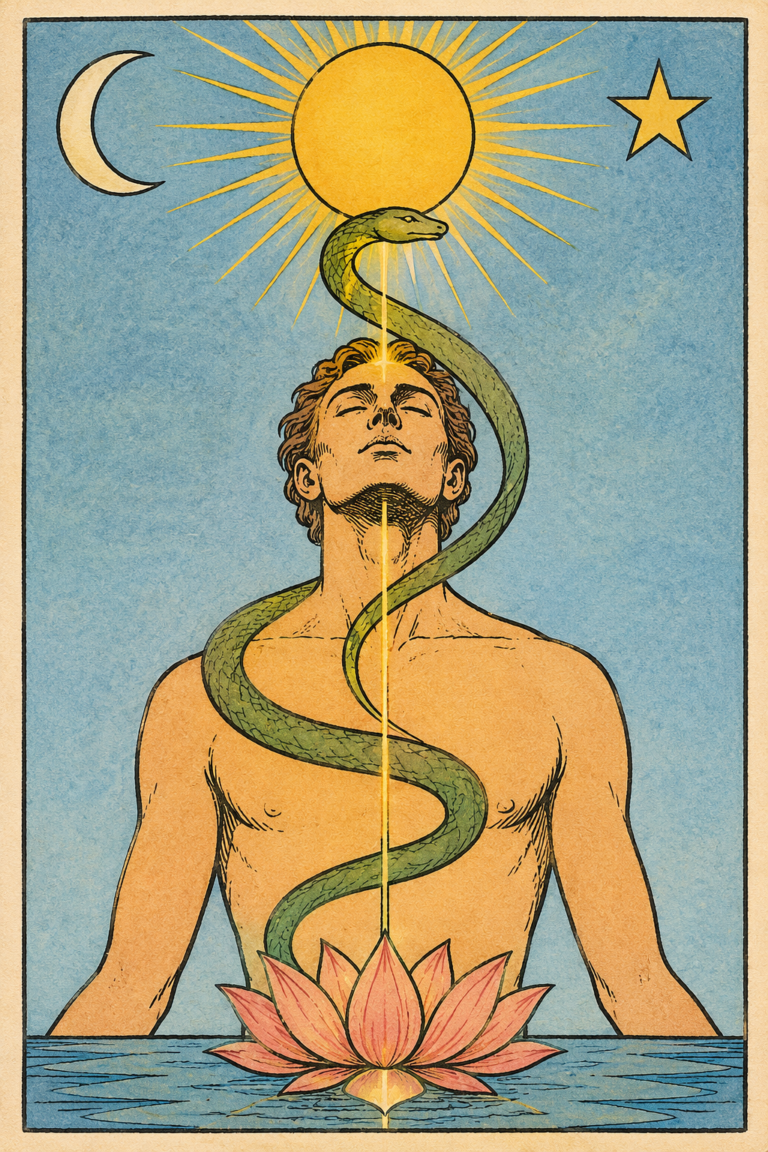
KUNDALINI AND SHADOW WORK – WHY SPIRITUAL DEVELOPMENT ALSO MEANS MEETING YOURSELF
A kundalini process can open up new dimensions of consciousness and bring experiences of depth, freedom and a different way of relating to the world. But the process can also bring aspects of ourselves to the surface that we might rather not have to face.
Old emotional wounds, unresolved conflicts, fear, anger, shame and patterns from past relationships can emerge and become difficult to ignore.
This is where shadow work can play an important role.
WHAT IS SHADOW WORK?
The shadow is a concept particularly associated with the Swiss psychiatrist Carl Gustav Jung. It refers to the aspects of ourselves that we have learned to suppress, deny or keep at a distance throughout our lives.
These may include emotions such as anger, envy, jealousy and grief. But the shadow can also contain positive qualities that we have not felt free to express: strength, independence, sexuality, vulnerability or the need to set boundaries.
We all develop strategies to gain acceptance, avoid conflict and protect ourselves from emotional pain. Over time, these strategies can become so deeply ingrained that we lose contact with parts of ourselves.
Shadow work is about recognising these aspects and exploring how they influence our lives.
WHY IS SHADOW WORK RELEVANT IN A KUNDALINI PROCESS?
When kundalini becomes activated, the familiar boundaries of our self-understanding may be challenged. Some people experience a greater sense of openness, changes in bodily awareness or a deeper connection with consciousness.
But spiritual experiences do not necessarily mean that our psychological patterns have disappeared.
We may have profound meditative experiences while still struggling with old relational patterns. We may experience unity and love in meditation, yet find it difficult to deal with anger, rejection or intimacy in everyday life.
A spiritual process can make us more aware of aspects of ourselves that we were previously able to keep at a distance. This can be uncomfortable, but it also creates an opportunity to understand some of the patterns that shape our lives.
FROM SPIRITUAL INSIGHT TO PERSONAL INTEGRATION
Without psychological work, there is a risk that we may use spirituality to avoid what is difficult. We may begin to identify with the idea of being beyond the ego, while old defence mechanisms and emotional wounds continue to influence our relationships and everyday lives.
Shadow work is not about eliminating the ego or becoming better people. It is about being more honest with ourselves and developing a more nuanced relationship with our own reactions, needs and emotions.
It can help us to:
- Understand recurring conflicts and patterns in our relationships.
- Reconnect with emotions we have previously suppressed.
- Recognise and gradually loosen old defence mechanisms.
- Become better at setting boundaries and acknowledging our own needs.
- Create greater coherence between our spiritual insights and the way we live.
Facing the parts of ourselves we have spent a long time trying to avoid can be challenging. This is why it is important that the process unfolds at a pace that allows for safety, understanding and integration.
KUNDALINI AND PSYCHOTHERAPY
In my work with kundalini-informed psychotherapy, I am particularly interested in the relationship between spiritual development and psychological maturation.
I do not see these two areas as opposites. Spiritual experiences can open up new perspectives, while psychotherapy can help us understand and work through the emotional and psychological dimensions of the process.
For me, it is not about reaching a particular spiritual stage or becoming free of all human difficulties. It is about becoming able to embrace more of ourselves – including the parts we might rather not have.
ARE YOU GOING THROUGH A KUNDALINI PROCESS OR SPIRITUAL AWAKENING AND FINDING IT DIFFICULT TO MAKE SENSE OF WHAT YOU ARE EXPERIENCING?
You do not have to navigate the process alone. In psychotherapy, we can explore your experiences, work with old patterns and find ways to create greater stability and integration in your everyday life.
I offer individual kundalini-informed psychotherapy in person in Frederiksberg, Copenhagen, and online in both Danish and English.
If you would like to explore whether psychotherapy could be helpful for you, you are welcome to contact me for a free, no-obligation introductory conversation.